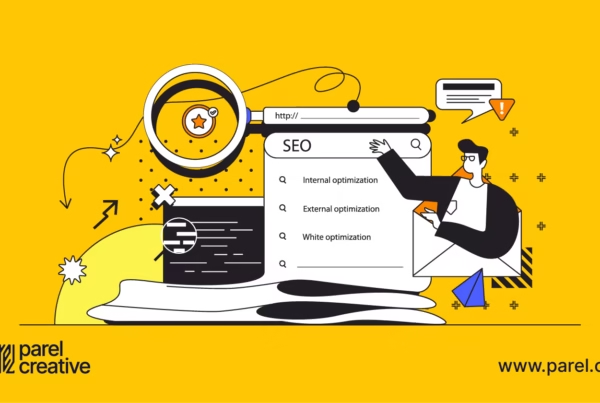



Search behavior has split in two. For twenty years, digital marketing meant one thing: rank in the top 10 blue links, write a good meta description, wait for the click. That’s no longer how most people find answers.
Whether someone’s using Google’s AI Overviews, ChatGPT, Gemini, or Perplexity, they’re increasingly asking full questions and getting synthesized answers instead of a list of links. If your business isn’t included in that answer, you’re much less likely to be part of the customer’s decision.
This is what Generative Engine Optimization (GEO) addresses. Researchers from Princeton, Georgia Tech, and IIT Delhi published a large-scale study on GEO in 2024, testing nine content strategies across 10,000 queries. The study suggests that content can be optimized to improve its chances of being cited in AI-generated responses.
1. Put your best answer first
Older SEO practices often encouraged long introductions and repetitive keyword use before getting to the main point. AI engines don’t read that way. They often retrieve tight, self-contained passages, so putting your strongest answers near the top helps, though relevant sections anywhere on the page can still be selected.
So lead every important page with a short, direct answer. Two to three sentences, 45-60 words, that state the point plainly before you explain it.
Also, drop the clever headers. “Everything You Need to Know” tells an AI very little. “How long does delivery take?” followed by a straightforward answer is far more useful.
2. Back every claim with a number
One of the clearest findings from the Princeton study was that pages with specific, verifiable details, especially statistics, were more likely to be cited by AI systems. Vague marketing claims are less useful than specific, verifiable information. Concrete numbers, dates, and benchmarks give AI something specific to reference.
Instead of writing, “Our cloud infrastructure improves uptime for banks,” write, “Our cloud infrastructure delivers 99.99% uptime and reduced banking system latency by 18% in our 2025 performance audit,” assuming you have the data to support those figures. The more specific your evidence, the more useful your content becomes for both AI systems and human readers.
3. Make sure AI can tell who you actually are
AI systems don’t rely on keywords alone to understand your brand. They identify real-world entities such as companies, people, and places, then use signals from across the web to verify and connect information about them. If your company’s identity is inconsistent or unclear, AI systems may be less confident about your content and more likely to surface another source instead.
Two fixes:
- Add clean JSON-LD schema (Organization, Product, LocalBusiness) to your site’s backend so there’s an explicit, structured record of who you are.
- Make sure your legal name, office address, founders, and service descriptions match consistently across your website, LinkedIn, Google Business Profile, and registrar records. Small mismatches can reduce confidence in your business information.
3. Build the comparison yourself
People don’t ask AI for a single recommendation anymore. They ask questions like, “Which project management tool is best for small businesses?” or “How does Product A compare with Product B?”
If your content only talks about your business in isolation, AI has little context for how you compare with other options. Create honest, structured comparison tables on your site that show your pricing, features, or capabilities alongside relevant alternatives. If you present a clear, balanced comparison, AI systems have an easier time understanding where your business fits and may use that information when generating responses.

The Next Steps
The old game was winning clicks. Now the goal is to become one of the sources AI systems choose when generating answers. That takes real technical work: clean schema, consistent entity data, and content built around hard numbers instead of vague claims.
At Parel Creative, we build that underlying architecture: structured data, technical SEO, and evidence-based content, so your brand is easier for AI systems to understand, reference, and surface in generated answers. If you want to see where your current setup stands, get in touch.